
Can Travel Be Social?
“Tourism in Florence is antisocial.”
That sentence caught my attention straight away. It came from someone who doesn’t usually talk in those terms, so I asked what he meant.
He talked about third spaces.
In many European cities, piazzas aren’t just tourist sights. They’ve always been everyday spaces. Places where people meet friends, argue about politics, watch life go by, or simply sit without needing to buy anything. They’re not decorations. They’re part of daily life.
Tourism, he suggested, becomes a problem when these spaces stop working for the people who live there.
Florence is often described as an open-air museum, but its art was never meant to be passive. Paintings, statues, and buildings once had clear roles in public life. They carried ideas, beliefs, and shared meaning. Art helped shape how people understood their city and their place in it.
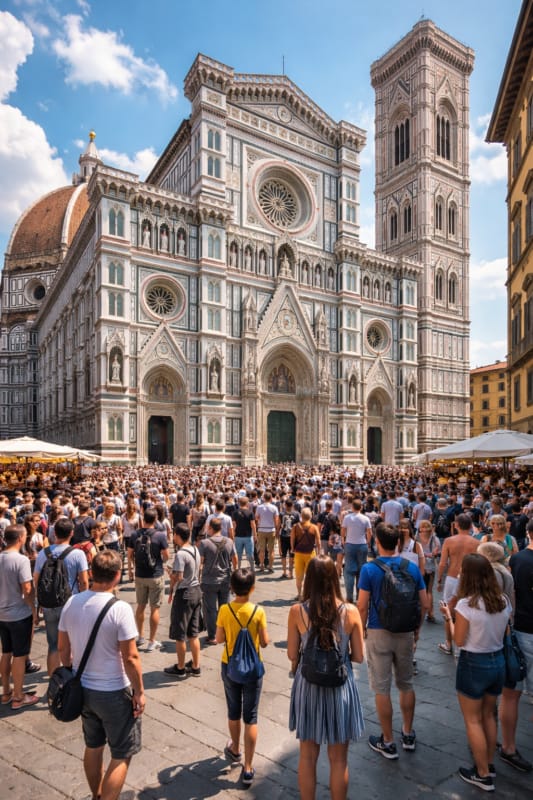
Today, many of Florence’s main squares feel different. They’re still beautiful, but often crowded, expensive, and focused on visitors. Locals pass through rather than linger. When a space is designed mainly for consumption, everyday life slowly steps aside.
This isn’t unique to Florence. Tourism often searches for “authentic” places, but too much attention can quietly change how those places work.
So what can be done?
One idea is that cities need stronger, more balanced economies. When most jobs depend on visitors, it becomes harder for residents to make choices based on their own needs. Culture turns into something that must be sold, rather than lived.
You can see this imbalance in small details. A few famous museums are overwhelmed, while others—equally public and meaningful—remain calm, underfunded, or partly closed. Attention and resources concentrate in predictable places.
Travelers also play a role. Travel works best as an exchange, not a demand. Wanting to understand a place is different from expecting access to its daily life. The more we chase a “local experience” as a product, the more distant it can become.
Cities don’t suddenly fall apart. They slowly lose their texture.
So maybe the question isn’t whether tourism is good or bad. Maybe it’s softer than that:
can travel leave enough room for places to keep being themselves, in everyday, ordinary ways?
#SustainableTravel
Thanks to an original article by Sara Ensing on Linkedin
 Follow
