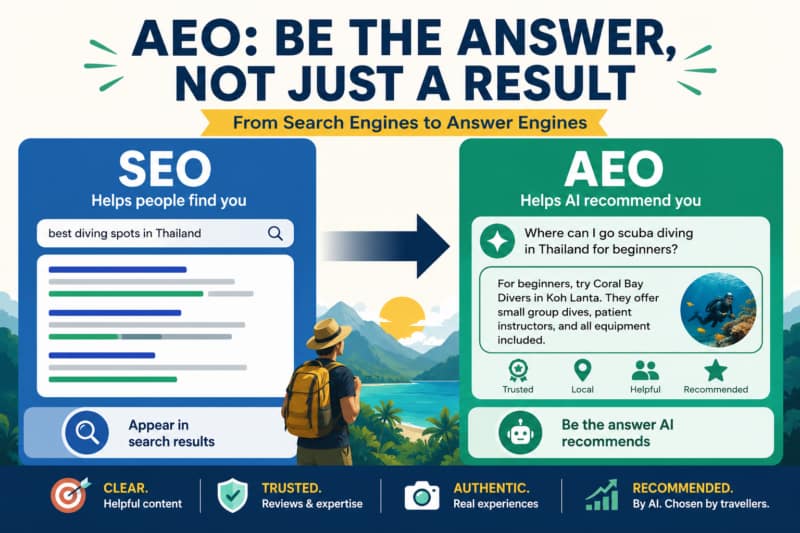
You already know that travelers are using AI to plan trips, compare options, and decide who to book with.
The question is: do you show up in AI when they do?
Most tourism brands have no idea. They keep hearing they need to show up in AI search, but nobody is actually explaining how to improve their chances.
AI search is evolving fast, and staying agile matters. Here’s what we’re seeing work right now.
Quickly Test Your AI Visibility
There are professional tools built to measure AI visibility, but here’s a simple way to get a general sense of where you stand.
Open ChatGPT, Perplexity, or Claude in a private window, one with no history of your brand. Search for the type of experience you offer, not your brand name. Try something like “best dude ranches in Montana” or “family rafting trips in Colorado.”
Results can vary, so treat this as a directional read rather than a definitive answer. And try it in more than one tool.
There’s only an 11% overlap between what ChatGPT and Perplexity surface (2025 AI Visibility Report), so showing up in one doesn’t mean you’re showing up in all of them.
Now here’s what to do to improve your AI visibility 👇
1. Define your brand clearly, then repeat it everywhere
Before AI can recommend your tourism business, it needs to understand your tourism business. Pick a short, specific descriptor and use it consistently across your website, Google Business Profile, OTAs, and social profiles.
“Small group food tours in Bologna for culinary travelers” is something AI can work with. “Authentic Italian culinary experiences” is not.
The more consistently AI encounters the same description of your brand across the web, the more confident it becomes recommending you. This is also just good practice for brand clarity in general.
2. Get mentioned in the right places
AI treats third-party references as validation. Features in travel publications, tourism board listings, regional press, and credible directories all signal that your brand is real, established, and worth recommending.
As AI models mature, brand citations are becoming increasingly important signals. The more frequently your brand appears in credible places, the more likely AI is to include you in recommendations and comparisons.
3. Use reviews to shape the narrative
Reviews are one of the strongest trust signals in AI search. But it’s not just about how many you have. It’s also about what those reviews consistently say about your brand.
AI systems analyze review sentiment, recurring language, and shared themes across traveler experiences. Brands with a steady stream of recent, detailed, and positive reviews are far more likely to be surfaced in recommendations, itineraries, and travel comparisons.
4. Keep your content fresh and structured
Outdated pricing, stale tour descriptions, and missing details reduce AI confidence in your brand. Update key pages regularly and use clear formatting.
FAQs, comparison sections, and “what to expect” content are especially powerful because AI can quote them directly in answers.
5. Strengthen your Google Business Profile
Google grounds its AI outputs in verified data. If your GBP is incomplete or out of date, you risk being skipped entirely in AI-driven recommendations.
As Google Canvas in AI Mode expands, GBP will matter even more. Google is moving toward personalized, preference-based trip planning inside AI environments, and your Business Profile is one of the primary signals it pulls from to generate those recommendations.
Update your amenities, upload current photos, use Google Posts regularly, and respond to every review.
6. Match your content to how travelers actually search
Travelers don’t type keywords into AI. They ask full questions and describe what they’re looking for. Your content needs to reflect that.
Spell out clear “if this, then choose us” scenarios. “If you want small-group wildlife tours away from the crowds, our Corcovado itinerary is built for you.” That kind of framing gives AI a simple rule it can reuse in recommendations.
As search becomes more conversational, individual keywords matter less than the topic ecosystem you build. Connected content, itineraries, comparisons, FAQs, and “what to expect” resources that reinforce one another give AI a deeper well to draw from, and brands with clear topical depth are the ones it trusts and recommends.
7. Start creating video content
Travelers consistently use video to evaluate destinations, hotels, and tour operators before booking. AI tools like ChatGPT and Perplexity reference video for the same reason: it provides clearer, more trustworthy context than text alone.
You don’t need high production value. Room walkthroughs, guide introductions, and on-site conditions filmed on a phone can significantly strengthen your visibility across both AI search and social platforms.
8. Build a social footprint with intention
The goal is omnipresence. Develop strong content once and repurpose it strategically across channels so AI repeatedly encounters your brand in multiple places, not just your website.
Active, consistent social posts give AI clearer insight into your brand, the experiences you offer, and how travelers engage with you in real time. And it’s worth noting that social posts can be indexed by Google, so showing up consistently across platforms improves your visibility on both fronts.
Found these tips helpful? Our full guide to AI visibility covers 7 more steps, plus a breakdown of how AI visibility works differently across each LLM.
Read the full article here:
AI Visibility for Travel Brands: Your Complete Guide to Showing Up in AI Search

 Follow